

A crypto analyst has announced that the XRP price has just entered a neutral state and could be gearing up for a major rally. He explains how this phase has historically appeared before strong rallies and outlines what the current market structure may signal for XRP moving forward.
XRP Price Enters Neutral State Before Bull Rally
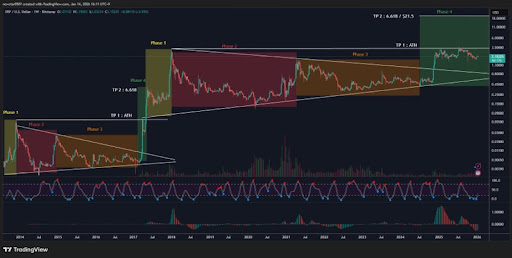
Crypto expert and data analyst CW recently shared a fresh update on XRP’s price action, noting that the cryptocurrency has broken out from its bottom and moved into a neutral state. He said this shift marks the early stage of a larger bull rally, with a decisive move above the previous all-time high acting as the key signal for price acceleration.
The chart he shared shows XRP following a repeated four-phase pattern across multiple market cycles, first from 2014 to 2018 and again from 2017 to date. In the 2014 cycle, Phase 1 began with a sharp breakout to TP1, setting a new ATH. From that peak, XRP entered Phase 2, which formed a Symmetrical Triangle. During this phase, XRP moved sideways within a tightening range for several months.
Phase 3 came next, marking a long consolidation period for XRP. Eventually, XRP’s price broke the upper boundary of the symmetrical triangle and entered Phase 4. In this final phase, XRP surged to TP2, reaching a second ATH at the 6.618 Fibonacci extension level.
According to the chart, XRP has already completed Phases 1-3 in the current cycle and has entered Phase 4. After hitting its first peak around $3.5 (TP1) earlier in 2025, the cryptocurrency recently broke above the upper boundary of a similar Symmetrical Triangle pattern, entering a “neutral state.”
Now that XRP has reached this state, CW noted that it has entered Phase 4, the final stage of the four-phase historical pattern. The analyst has projected a second new all-time high for XRP near $21.5, aligning with the 6.618 Fibonacci extension level from the 2014 cycle.
How Momentum Indicators Reacted During Each Phase
At the bottom of CW’s price chart is a Stochastic Oscillator and a Moving Average Convergence Divergence (MACD) histogram. The stochastic shows overbought and oversold conditions for each cycle.
In Phase 2 of each cycle, the stochastic frequently hits oversold levels, which align with the extended consolidation and price decline observed in that period. During Phase 3, it stays around the middle range, reflecting a neutral state. Finally, in Phase 4 of the 2014 cycle, it spikes toward overbought levels, coinciding with strong price breakouts.
Meanwhile, the MACD histogram mirrors momentum shifts in each phase. During Phase 1, the histogram shows strong positive bars during the initial breakout. Phase 2 saw negative bars as the price declined, signaling bearish momentum. After this, Phase 3 showed small, fluctuating bars, indicating low momentum. Lastly, in Phase 4, the histogram rapidly expands on the breakout, pushing its price to new ATHs in 2014.

